Monday, January 27, 2014

Puerto de Vita to Baracoa

Posted by Scot.  Written Jan. 14, 2014.

After waiting a couple of hours for the harbourmaster to show up, we pulled away from the dock at Puerto de Vita at around 1230, and sailed back out into the Bahama Channel.  As we motorsailed east into the wind, we passed the all-inclusive resorts lining the shores at Guardalavaca (I love that name.  Translated directly into English, it means “Guard the cow”).  Anyway, we got a good close-up look at quite a few of the Canadian tourists staying at the resorts, since we sailed right through the fleets of Hobie cats they were sailing off the beaches.  Several of them waved and shouted their surprise as they saw us sail by with our Canadian flag.

P1010605
Leaving the all-inclusives behind.
As the sun went down, the waves came up a bit, but the wind was just right for us to sail at about 60 degrees off, and we made good time.  Christopher and Alexander repeated their evening watch, sitting at the helm from 7:30 to 9:30, which gave Sara and I a good chance to rest.  It seems when it gets dark, and the motion of the boat is hard to predict, it becomes a bit more nauseating, and both Sara and Christopher suffered from the effect.

P1010606
The sun sets at sea.
It didn’t stop anyone from falling asleep, though, and shortly after I took over at 9:30, the boat was silent.  Unfortunately, it was about then that the wind shifted right around onto our nose, so I fired up first one engine, then both, and we plowed on through the waves.

When we sailed from the Bahamas down to Cuba, we didn’t see any sign of the typical ship traffic in the Old Bahama Channel.  Sailing along the north coast of Cuba, we made up for it.  We were accompanied all night by freighters and cruise ships sitting about 5 miles out to sea.  It was easy to see their lights, despite the distance, and the AIS proved entertaining, as it showed us their names, sizes, speeds and destinations.
Sara took over at around midnight, and kept watch for most of the rest of the dark hours.  Around 4 a.m., I woke up, and we kept watch together for awhile.  Then Sara lay down for a couple more hours of sleep, and I got to see the sunrise.  As the day lightened, the dramatic shore of northern Cuba was revealed, with mountains rising straight out of the water, covered in palm trees and green jungle.  Apparently when Columbus first landed here, he said it was some of the most beautiful land he had ever seen.  It hasn’t changed much since then.

P1010612
El Yunque greets us as we approach Baracoa.

Sailing into the small pocket bay at Baracoa was equally impressive.  The dramatic flat-topped El Yunque de Baracoa makes an impressive backdrop.  Baracoa itself is a remarkably beautiful spot, with a real “end of the earth” feel.  The steep mountains all around make it hard to get to, and apparently for a long time it was completely isolated from the rest of Cuba.

P1010625
El Yunque from inside the bay.

P1010628
Local fishing boats in Baracao Bay.
P1010630
A hotel with a view overlooking Baracoa Bay.
Once we arrived, the Guardafrontera called us on the radio, and told us they would need to come out to the boat to check our paperwork.  What they didn’t tell us was that they didn’t have a boat of their own, so after sailing all night, I had the pleasure of dropping our dinghy into the water, pumping it up, and rowing over to the commercial dock to pick him up.  We don’t have our outboard motor on the dinghy right now, since it is easier on our dinghy davits if we sail with it on the big boat.  We didn’t think we would be using the dinghy much, since we were assured at Puerto de Vita that we would not be able to go ashore at any of our stops along the way, until we were at the official government marina in Santiago de Cuba.  To our welcome surprise, though, the Guardafrontera told us we could go ashore, as long as we left one person on the boat for “security”.

Is News Paper?

Posted by Katie.  Written Jan. 11, 2014.

P1010595
The Monashee News!  Get it while it's hot!
Breaking News!  On Monashee there has been a serious talk about Newspapers and that is because of Katie’s new idea the Monashee Press News!  With  every day a new paper comes out in the morning at about 8:00 am.  Every news on the boat is made a  day before so the staff does not have to wake up at 4:00 am in the morning to work on it.  The news is not just one person though me and Christopher are the only members besides alexander who does small columns form time to time.  Sometimes he even takes one of Christopher’s job for the day. 

The columns that keep us busy every day are listed here: News, Kids, Events, Fun and comics. Sometimes we even do movie reviews.  The News section is all the varieties of news we have on and off the boat.  The Kids page is things that only kids would be interested in.  The events page is to make sure you are aware of parties, visitors, performances and more.  The Fun page is  for  riddles, jokes and mazes so far but  I have a hunch that I am going to think of more things to do on that page.  And last but not least comics are what you would think they are, comics, and I don’t think there is much more to it. So go ahead and start your own news paper I did not copywrite it.

P1010596P1010597P1010602P1010600

Sunday, January 26, 2014

Gibara (Pronounced Hibara)

Posted by Alexander, Sara and Scot.  Written Jan. 9, 2014.


P1010566
Fishing boats in the bay at Gibara.

As we drove into Gibara we saw the Silla de Gibara. It was a huge lone mountain, shaped like a saddle, that rose out of the countryside. I wish we could have seen more of it but as we zipped past it was already gone. Gibara lay just ahead. The taxi dropped us off right at the Casa Particular that we were going to stay at. It was supposed to be better than the last one we stayed at and I prayed it was. My pillow had felt like it was made of lead and I slept very uncomfortably. As we entered we got a good look at the place and I instantly liked it. There were pictures of the owners family all over and a shaded garden in the back. After mom peeking at our would be rooms we were told that we could come back at three  The people staying in the rooms would be gone by then. And so leaving our bags in the Casa, we embarked on an exploration of Gibara.

We strayed around the town keeping a watchful eye out for a place to eat. We wandered along the sea wall, saw the center of town and finally went the way I wanted to go. We had heard there would be a good restaurant at the top of a hill overlooking Gibara. It was supposed to be right next to the remains of an old Spanish fort. It was where I was interested in going because as unusual as it seems, I was hungry. While we plodded along the streets I noticed many positive differences between Gibara and Holguin. It was a smaller town and the streets were less crowded. The activity was less frantic and you weren’t about to be run down by cars and bikes at every street corner. It was just, in general a quieter place.

P1010543
The tour guide, reading from Lonely Planet to teach us a bit about Gibara.
P1010550
Horsepower?  One.
P1010559
El Centro, Gibara.
On our way to the hill we saw a building taller than all the others and nicer looking. We went in and saw it was the best hotel we had seen since Nassau! Mom checked to see if we could eat there but the desk person said that they would have to check with the chef because another group had reservations. We sat in the lobby while this exchange went on and I knew everyone was wishing we had come to stay here instead.

We decided to go see the hill anyways. At the top of the steps Christopher and I sat and watched some huge birds of prey glide along the winds. Katie joined us while Mom and Dad still climbed. Annoyingly, we got approached by some guys peddling little wooden toys. As funny as the toys were we said “no, gracias”, but of course Cubans aren’t turned down so easily. Dad managed to shake them off when he showed up. The restaurant up there was a disappointment along with unremarkable crumbling tower and wall that was what was left of a Spanish fort. 

P1010551
Relaxing in the Hotel Ordono in Gibara.  This was the nicest place we had seen in months.
P1010558
At the top of the stairs, overlooking the windblown Malecon in Gibara.
We decided to eat at the hotel and it was worth it! My spaghetti was delicious and we were offered to be shown some rooms. As we went through I could see Dad and Christopher wincing at our choice of room and board. These rooms were up to par with good first world hotels, the food was no more expensive than the common Cuban fare and there was an amazing view from the rooftop lookout.

P1010561
Fancy lunch in the Hotel Ordono (cost about 6 or 7 dollars per person).
At that point we wandered back to the Casa Particular to learn that the people who had our rooms still weren’t back. We waited a while and when they finally came back they took ages to leave. We leapt at the chance. We said we needed to rest and we were going to the hotel instead. The owner seemed to understand.

P1010570
Waiting for our rooms in the casa particular in Gibara.

While mom registered us at the hotel, a hostess came and gave as all cool fizzy drinks and damp cool cloths to cool us off. It was heaven. Our rooms were awesome and dinner was great! (aside from taking quite a while because of a large German tour group that was eating at the same time as us).  There was a band of three women with guitars and castanets. They were really good and I was glad we got a taste of Cuban culture like that.

P1010577
Live entertainment with dinner.  Pretty much everyone in Cuba seemed to either play an instrument or dance.  There was music everywhere.

After a peaceful night in the luxurious rooms, we went back to the restaurant for the Cuban breakfast, included in the price of the hotel.  We were alone in the restaurant in the morning.  The woman in charge of PR for the hotel came by our table to see how we were doing, and we started to chat with her about regular Cuban life.  She told us all about the hotel, which had just been restored and was less than a year old.  It had originally belonged to the wealthiest family in Gibara (pre-revolution), who had lived on the third floor where our rooms were.  It was now run by the government, like all hotels in Cuba.  The restoration had tried to be true to the original, and the murals on the walls in the bedrooms, and the fancy woodwork on the ceilings had all been  returned to their original state.  The lookout on the roof had been built by the original owner after his wife died, so he could see her grave.

P1010575
Restored ceiling in one of our hotel rooms.

P1010567
The central hallway outside the floor with the rooms.
P1010554
Poster, showing the restoration of the Hotel Ordono.
The PR lady also told us a bit about her life.  She told us that, while Cubans were free to stay in the hotel if they wanted, the reason we didn’t see any was because of the cost.  For example, she said, the workers in the hotel all made a wage of about $20.00 CUCs (about $23.00 Canadian dollars) per month.  So a night in the hotel would cost 3 or 4 months salary for them.  And that is without eating in the restaurant.  She also talked about Cuban education, telling us that her English was so good because she had a bachelor’s and master’s degree in public relations, and had studied a lot of English in University.  She had previously been a teacher, but working in the hotel, for $20.00 CUC per month, was a better wage, so that is what she did now.  She hitch hiked back and forth to work every day, since she and her husband didn’t have a car.

P1010573
View from our luxurious hotel room out over the rest of Gibara.

Mom asked her about buying some groceries for us to take back to the boat, and she offered to take Mom around to the shops and help her buy some things.  The shopping was “European style”, with different stores for different kinds of food.  The first places they went were two stores that were similar to corner stores like we would have at home, looking for snack food.  The supply of food was limited, but they managed to buy some cookies in the first store, and some small pre-packaged muffins in the second.  They then went around the block to the bakery where there was a 20 minute lineup for fresh bread.  Our hostess bypassed the line to buy us 4 baguette type loaves for a total of about $0.25 CAD.

After that, they walked a couple of blocks to pick up eggs from a farmer who had brought them into town that morning.  A block later, a man was selling vegetables off a cart in the street.  After a lot of searching, it became clear that there was no cheese available for purchase in Gibara.  We rounded out our grocery shopping by stopping at one of the roadside fruit stands on the way back to our boat.

P1010582
Fruit stand, on the highway to Guardalavaca.

P1010584
Enjoying the fruits of our journey, back at the boat!

All in all I got a really good impression of Gibara. If anyone is ever there they should stay at the Hotel Ordono. I would love to stay there again if I got the chance.

P1010569
Gibara malecon.

Holguin

Posted by Scot and Sara.  Written Jan. 8, 2014.

I’m not sure how to even begin describing Cuba.  It is full of contradictions and contrasts.  It is remarkably poor, but in spite of that the people are friendly, vibrant, and appear happy.  The countryside is lush, green, tropical, and beautiful, while the cities we have seen are run down and decaying.  Despite that, they are anything but grim.  They are filled with active, busy, well educated people who seem fulfilled just going about their everyday lives.

And there are not just people.  Animals are everywhere.   In the morning, you are awakened to the sound of  roosters crowing, even in the heart of the city.  There are skinny puppies playing in the ditch, goats, cows and horses grazing wherever there is a patch of grass and pigs squealing as they are carried down the city streets, eventually bound for someone’s dinner table.

The transportation is a story unto itself.  Taxis are largely 1950’s American automobiles, which are lovingly cared for.  Anything more recent is a foreign import, with cars like Hyundais, Ladas and Peugeots being frequent.  There are almost no truly modern cars.  Every vehicle is well used, and well taken care of.  Most Cubans, though, can’t begin to afford a car, and consequently the roads are filled with bicycles, horse drawn carriages, motorcycles (many with sidecars), pedestrians, and bici-taxis.  The carriages are drawn by ribby horses who trot along with their heads held high.  And when they aren’t pulling a cart, they are tethered at the side of the road, eating the grass down to the dirt.  After the sleepy villages of the Bahamas, the sheer volume of people out on the roads and the streets in the heat of the day is astonishing.

P1010467
Most of the traffic on the highways is non-motorized.  Cars and buses are relatively infrequent.
P1010512
The ubiquitous bici-taxi in Holguin.  These guys usually stopped their calls to us when they realized there was five of us.
P1010531
Horse drawn carriage from our casa particular.
P1010507
El Centro in Holguin.
P1010504
This car would be cool in any country.
We left the Marina Gaviota in Peurta de Vita a couple of days ago to see some of Cuba by land.  We were frustrated by our attempts to rent a car at one of the nearby all-inclusive resorts.  It seems that right now is high tourist season and cars (like many things on the island) are hard to come by.  As it turns out, over most distances of less than a few hours, it is probably cheaper just to hire a taxi and be driven where ever you want to go.

So that is what we did.  Yoel picked us up at the marina in his red 1955 Chevrolet.  We all piled in, Katie and Scot in the front and Alexander, Christopher and I in the back.  In 1955, apparently seatbelts were not an option, and seatbelt laws haven’t made their way to Cuba, so we just hung on tight.  We drove the 45 minutes into Holguin through the beautiful Cuban countryside.

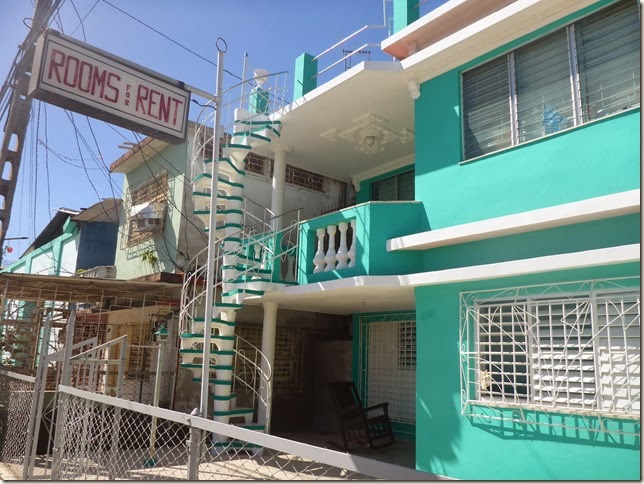
Yoel dropped us off at our casa particular, which is a private house that rents rooms (like a B&B.)  Since Raul Castro took over from his brother Fidel in 2008, more private business, like Yoel’s taxi, or these casa particulars, have been allowed, allowing an improved standard of living for those that can afford to set up shop.  The casa particular we stayed at in Holguin was right on the main thoroughfare, which was a noisy and busy place, just a few blocks from the central square, known commonly as El Centro in Cuban cities.  It was a bit of a shock for the kids to see where we were going to spend the night, and probably a bit for Sara and I too.  But it was an amazing taste of a real Cuban household.
P1010477
Our casa particular in Holguin.  We had two rooms - one right at the top of the spiral staircase, and one out the back.
P1010533
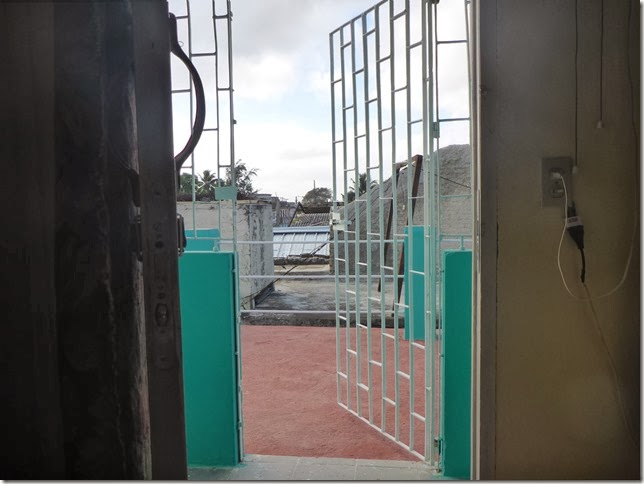
The view from the room at the top.
P1010518
There was a little sitting area outside the upstairs room.
After we dropped our bags off, we set out to explore Holguin.  It didn’t take long for the local touts (called jinteros in Cuba) to suss us out, and before long we had several offers for people to show us around, sell us cigars, toys, flowers, snacks, or anything else they could supply that we might want.  We did take one enterprising fellow up on his offer to help us find a bank, which we had unknowingly walked past earlier.  It took us a bit to get used to the fact that you have to stand in line for pretty much any service you might want in Holguin.  After changing some money, we set out to explore the rest of the town on foot, getting better at saying “No gracias” to everyone who either wanted to sell us something, or was just outright asking us for money.

P1010483
"Battalando Siempre" with Fidel.
P1010514
There is a lot of public art in Cuba.  We think this mural shows some of the history of Holguin.
P1010509
Spot the tourist.  Bet you got it in one guess.
P1010488
Revolution era playground.  Pretty rare in Cuba.
We climbed La Loma de la Cruz, the hill with 432 steps that towers over Holguin, so we could look back and enjoy the view.  At the top of the climb, we indulged in a rare touristy purchase, buying Katie a small painting on display by the talented artist that had taken his wares to the top.

P1010492
Walking to La Loma de la Cruz.  Note the jintero in the red t-shirt to our left, who is about to move in for the kill.  He was joined by about 10 colleagues at the bottom of La Loma.
P1010502
All of Holguin spread out below us. 
Coming back down into Holguin, we stopped for ice cream and bought a phone card after waiting in line  on the street to enter the Etecsa Telepunto (they only let so many people inside the store at one time.)  After many tries and some frustration, we finally figured out how to work the phone card and then called to reserve accommodation for the next night in the seaside town of Gibara.  We had hoped to stay in the Lonely Planet recommended boutique hotel but there was no answer on their phone, so we booked another casa particular.  This one was also a recommendation from the Lonely Planet book so we were hoping for something of a bit higher standard than our place in Holguin.  

P1010515
For those under 20, that things Sara is using is called a payphone.  Her Spanish has held up well since her year in Mexico, and it was a huge benefit in Cuba.
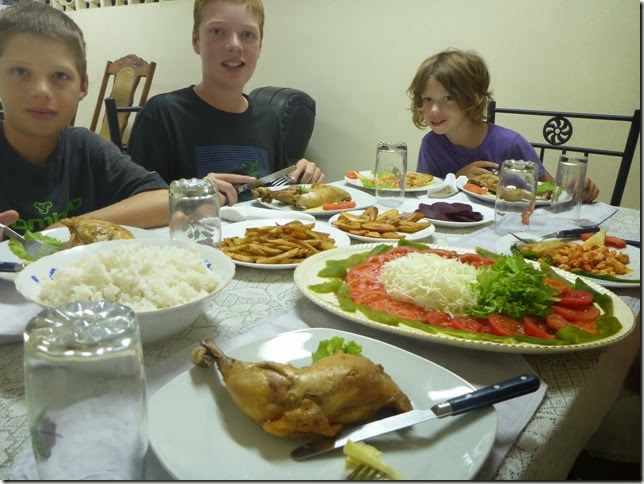
That night, we had dinner in our casa particular.  It was a wonderful home cooked meal with carrot soup to start, a main of fried chicken, grilled fish and shrimp accompanied by rice, salad and fruit.  Delicious and healthy.
P1010524
Home cooked meal in the casa particular.
The night was a bit rough with lumpy beds – just imagine a 40 year old pull-out couch – but only Scot and Alexander and I noticed.  Maybe Katie and Christopher are too light for it to be an issue.  The breakfast was delicious –  fresh squeezed pineapple juice, hot coffee with warm milk, plates of fruit, toast & butter, ham, cheese and fried eggs.

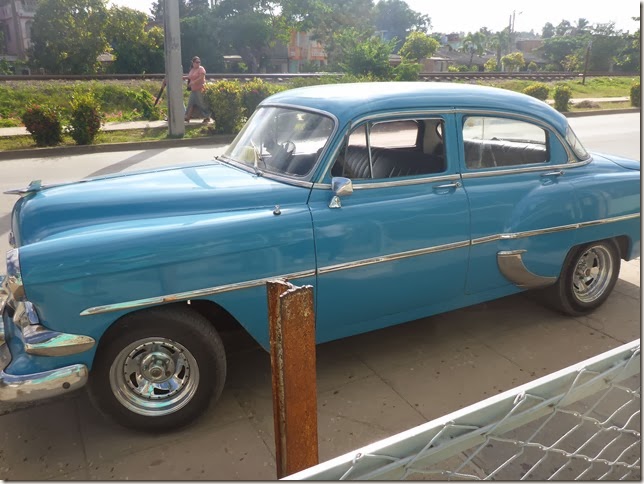
At 10am our taxi (another 1950s vintage American car) picked us up to take us the 45 minutes to Gibara.  Once again we all piled in with no seat belts.  When we arrived in Gibara we dropped our bags at our new casa particular before going to check out the sleepy sea side town.  The people who had stayed in the casa the night before had gone to the beach for the morning and were supposed to return in the early afternoon so our rooms wouldn’t be ready until later in the day.
P1010534
Taxi to Gibara.  This one was decked out with false wood panelling on all the floors.

Saturday, January 25, 2014

Welcome to Cuba

Posted by Alexander.  Written Jan. 6, 2014.

Today was our second day in Cuba. And the first we saw much of it. You see we have this awesome plan of renting a car and going on a road trip to see some of Cuba. Of course to do that we needed to rent a car so we hired a cab to check out the rental places. The taxi that pulled up was a red Chevrolet that could have been driven out of the sixties. (Back to the future anyone?)  (Dad’s note; Actually, it was a 1955 Chevrolet, with a Hyundai engine in it.  We saw lots of classic cars all day.)


P1010437
The Cubans have a thing for old cars.  I think that thing is called "necessity."
P1010457
Yoel and the family in front of his 1955 Chev.
The driver was a Cuban who’s name we later learned was Yoel. I’m pretty sure the only English that he knew was the word “Yeah” but that’s ok. The reason why is because I have an awesome mom who used to be fluent in Spanish and hadn’t forgotten all that much. She was basically our translator for the whole trip. I tried my best to talk to throwing in the occasional “gracias” or “hola” when necessary. Dora has nothing on me. As we drove through the lovely countryside we passed countless horses, cows and goats.

Our first stop was an all-inclusive hotel, where we changed some Canadian dollars into Cuban convertible pesos ($1.11 Canadian bought $1.00 CUC). In the lobby of the hotel was a big white board signed by Fidel Castro, who had visited the hotel in the past.

P1010442
The lobby of one of the all-inclusive hotels near Peurto de Vita.  Fidel was here at the opening.  Unfortunately, they wouldn't let us go in, since we weren't guests.
After that, Yoel took us to a local village called Melila.  We had been asking him about where he lived and what local schools were like, so he showed us around a bit.  Then, he took us on a dirt road to a local house.  We didn’t even ask to go there but it was WORTH IT! A lady greeted us there and we ended up going into her backyard. Of course she only spoke Spanish but we realized Yoel had taken us to a sort of local zoo. This lady had tons of animals in her backyard, most of them in cages.

There were dogs, (not in cages), hamsters, turtles, guinea pigs, (we got to hold them, awwww) a falcon, some turkeys, pigs that kinda stunk, barn owls, some pigeons, parakeets and a ton of other stuff. They even had a crocodile back there! They also had a big rodent thing in a cage which was cute in itself. We learned that it was native only to Cuba and that was cool. The best part was it had three babies that were climbing freely in the trees. Adorable right? They had a ton of plants too and we saw that they grew their own bananas with which to feed most of the animals. We got to try some and they tasted good.

P1010455
A hutia, endemic to Cuba.
P1010452
Falcon.
P1010451
Pigs.  Smelly but cute.  In Cuba, usually these guys end up on someone's dinner table.
P1010449
Barn owls.
P1010447
Another raptor.
P1010445
A crocodile, and his pal the turtle.
P1010443
This parrot spoke a little Spanish.
We left the lady with a five CUC note and drove off with awesome memories. After that we got lunch. Yoel ate with us. That’s when we learned his name. They had fresh tasty banana chips that I devoured. After that Yoel kept grabbing more and laughing as he offered them to me. I had plenty but tried to explain I didn’t need more. He got it after the second plate. Mom and Dad learned a lot from asking him questions. We learned that Fidel Castro hadn’t supported private business like the restaurant we were eating at (called a paladar in Cuba). Raul Castro had allowed private business to thrive though which was good.

After lunch we went around and saw a ton of car rental places but none of them had any  cars for Tuesday!  When we finally finished running around we said goodbye to Yoel and went back to the boat. I asked if we would still go on the trip but Mom and Dad have a plan.